Average Number of Packets Per Second for Family

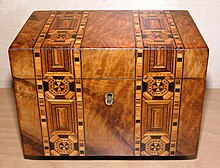
An English tea caddy, a box used to store loose tea leaves
Since the 18th century, the United Kingdom has been i of the earth'due south largest tea consumers, with an average annual per capita supply of one.9 kilograms (four.2 lb).[1] Originally an upper-class drink in Europe, tea gradually spread through all classes, eventually condign a mutual drink. Information technology is still considered an of import part of the British identity[2] and is a prominent characteristic of British culture and order.[3]
In both the United Kingdom and the Republic of Republic of ireland, tea-drinking blends and preferences vary.[4] Although typically served with milk, it is likewise common to drink sure varieties blackness or with lemon. Sugar is a popular addition to whatever variety. Everyday tea, such as English language breakfast tea, served in a mug with milk and saccharide is a pop combination. Sandwiches, crumpets, scones, cake, or biscuits frequently accompany tea, which gave rise to the prominent British custom of dunking a biscuit into tea.
History [edit]

A tea plantation in Prc, showing workers packing the tea into boxes

Philippe Sylvestre Dufour, 'A treatise on tea', in his A treatise on the novelties and curiosities of coffee, tea and chocolate, c. 1671
The rise in popularity of tea between the 17th and 19th centuries had major social, political, and economic implications for the Kingdom of Great Britain. Tea defined respectability and domestic rituals, supported the rise of the British Empire, and contributed to the rise of the Industrial Revolution by supplying both the upper-case letter for factories and calories for labourers.[5] Information technology besides demonstrated the power of globalisation and its power to transform a country and reshape its club.[six]
Historiography [edit]
Ukers argues in All Nearly Tea: Volume I that tea gained popularity in Swell Britain due to its reputation as a medicinal potable and its burgeoning presence in coffeehouses where elite men congregated.[7] Equally for the popularity of tea among women, he briefly acknowledges that Princess Catherine of Braganza, the future queen consort of England, fabricated tea fashionable among aristocratic women, only largely attributes its popularity to its ubiquity in the medical soapbox of the 17th century. In Empire of Tea: The Asian Leaf that Conquered the World, authors Ellis, Coulton and Mauger trace tea'due south popularity back to three distinct groups: virtuosi, merchants, and elite female aristocrats.[8] They argue that the influence of these 3 groups combined launched tea every bit a popular potable in Uk.
Smith, in his article "Complications of the Commonplace: Tea, Sugar, and Imperialism", differs from the beliefs of the previous writers. He argues that tea but became popular in one case sugar was added to the drink and that the combination became associated with a domestic ritual that indicated respectability.[2] Mintz, in both "The Irresolute Roles of Food in the Story of Consumption" and Sweetness and Power, agrees to an extent with Smith, acknowledging that sugar played a monumental role in the rise of tea, but he contradicts Smith'southward connection of tea to respectability.[9] While Smith argues that tea commencement became popular in the home, Mintz claims that tea was drunkard during the workday for its warm sugariness and stimulating backdrop,[10] elaborating that it was subsequently that tea entered the home and became an "integral part of the social fabric".[5]
17th century and before [edit]
Early on mentions [edit]
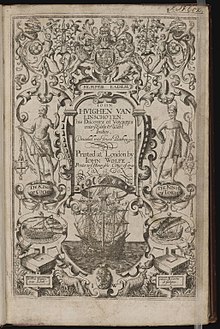
The history of European interactions with tea dates back to the mid-16th century. The primeval mention of tea in European literature was past Giambattista Ramusio, a Venetian explorer, as Chai Catai, or "Tea of Cathay", in 1559.[11] Tea was mentioned several more times in diverse European countries afterwards, only Jan Hugo van Linschooten, a Dutch navigator, was the kickoff to write a printed reference of tea in English in 1598 in his Voyages and Travels.[12]
Nonetheless, information technology was several years afterwards, in 1615, that the primeval known reference to tea by an Englishman took place. In a alphabetic character, Mr. R. Wickham, an agent for the British East Republic of india Company stationed at Nihon, asked a Mr. Eaton, who was stationed in so-Portuguese Macao, Mainland china,[13] to transport him "a pot of the best sort of chaw",[thirteen] phonetically an approximation of "chàh" , the local Cantonese dialect discussion for tea. Some other early on reference to tea appears in the writings of trader Samuel Purchas in 1625.[14] Purchas described how the Chinese consumed tea equally "the pulverization of a certaine herbe chosen chia of which they put as much as a walnut shell may incorporate, into a dish of Porcelane, and drink information technology with hot water".[14] In 1637, Peter Mundy, a traveller and merchant who came beyond tea in Fujian, China, wrote, "chaa – simply h2o with a kind of herb boyled in it".[15]
Sale of tea begins [edit]

1746 map showing Exchange Aisle, where tea was first sold in England
Though there were a number of early mentions, it was several more than years before tea was actually sold in England. Dark-green tea exported from Mainland china was first introduced in the coffeehouses of London shortly earlier the 1660 Stuart Restoration.[16]
Thomas Garway, a tobacconist and coffee house possessor, was the first person in England to sell tea as a leaf and beverage at his London coffeehouse in Exchange Alley in 1657.[17] [18] He had to explain the new drink in a pamphlet. Immediately after Garway began selling it, the Sultaness Head Coffee Firm began selling tea as a beverage and posted the first paper advertizement for tea in Mercurius Politicus on 30 September 1658.[19] The announcement proclaimed, "That Excellent, and by all Physicians canonical, China drink, called by the Chinese, Tcha, by other nations Tay alias Tee, ...sold at the Sultaness-head, ye Cophee-house in Sweetings-Rents, past the Royal Commutation, London".[xx] [nineteen]
In London, "[c]offee, chocolate and a kind of drinkable called tee" were "sold in most every street in 1659", according to Thomas Rugge's Diurnall.[21] Notwithstanding, tea was still mainly consumed by upper and mercantile classes. Samuel Pepys, curious for every novelty, tasted the new drink on 25 September 1660 and recorded the experience in his diary, writing, "I did ship for a loving cup of tee, (a Mainland china drink) of which I had never had drunk before".
The British East Bharat Company made its commencement society for the importation of tea in 1667 to their amanuensis in Bantam, who then sent two canisters of tea weighing 143 pounds (2,290 oz) in 1669.[22] In 1672, a servant of Baron Herbert in London sent his instructions for tea making, and warming the delicate cups, to Shropshire:
The directions for the tea are: a quart of spring water just boiled, to which put a spoonful of tea, and sweeten to the palate with candy sugar. Every bit soon as the tea and carbohydrate are in, the steam must be kept in as much as may be, and allow information technology lie half or quarter of an hour in the heat of the fire but not boil. The little cups must be held over the steam before the liquid be put in.[23]
The earliest English language equipages for making tea date to the 1660s. Small porcelain tea bowls were used by the fashionable and were occasionally shipped with the tea itself.
Tea as a medicinal drinkable [edit]

The beginning gene that contributed to the ascension in popularity of tea was its reputation every bit a medicinal drink. Tea first became labelled as a medical drink in 1641 by the Dutch physician and managing director of the Dutch E Bharat Visitor Nikolas Dirx, who wrote under the pseudonym Nicolaes Tulp;[24] in his volume Observationes Medicae, he claimed that "nada is comparable to this plant" and that those who use it are "exempt from all maladies and reach an extreme one-time age".[25] Dirx went into considerable particular on the specific merits of tea, such equally curing "headaches, colds, ophthalmia, catarrh, asthma, languor of the stomach, and intestinal troubles".[25] Thomas Garway, the start English shopkeeper praised the medical benefits of tea in a broadsheet published in 1660 titled "An Exact Description of the Growth, Quality, and Vertues of the Leaf TEA". Garway claims that "the Beverage is declared to be near wholesome, preserving in perfect wellness until extreme Onetime Age", as well as "maketh the torso active and lusty", "helpeth the Headache", "taketh away the difficulty of breathing", "strengtheneth the Memory", and "expelleth infection".[26]
At that place were many more published works on the health benefits of tea, including those past Samuel Hartlib in 1657, Cornelis Bontekoe in 1678, Thomas Povey in 1686, and Thomas Tryon in the 1690s;[27] [28] [29] one satirist of the time asked if the Imperial Higher of Physicians could debate whether any of the exotic new hot drinks would "concur with the Constitutions of our English language bodies".[xxx] In 1667, Pepys noted that his wife was taking tea on medical advice – "a drink which Mr Pelling the Pottecary tells her is expert for her colds and defluxions". English language philosopher John Locke adult a fondness for tea later spending fourth dimension with Dutch medical men in the 1680s.[31] These men are the "virtuosi" referred to by Ellis, Coulton, and Mauger: scientists, philosophers, and doctors who beginning took an interest in tea and contributed to its early popularity as a pharmaceutical.[32] However, as with Dirx, some of these men may have been influenced by the Indies trading companies and merchants who wished to create a market for tea. Nevertheless, these writings nearly the perceived health benefits of tea contributed to the rise of the beverage's popularity in England.
A 2022 written report institute that ascension tea consumption during the 18th century in England had the unintended impact of reducing bloodshed rates, as it led more than people to boil their water, thus reducing their vulnerability to waterborne diseases.[33]
Popularity among aristocrats [edit]

Co-ordinate to Ellis, Coulton, and Mauger, "tea was six to ten times more expensive than coffee" in the 1660s, making it a costly and luxurious commodity.[34] The proliferation of works on the health benefits of tea came at a time when people in the upper classes of English language club began to take an interest in their health, farther bolstering its popularity.
In 1660, 2 pounds (0.91 kg) and 2 ounces (57 g) of tea bought from Portugal were formally presented to Charles II of England by the British East India Company.[35] The drink, already common in Europe, was a favourite of his new Portuguese bride, Catherine of Braganza. She introduced it at Domus Dei in Portsmouth[36] during her hymeneals to Charles II in 1662 and made information technology fashionable amid the ladies of the court as her temperance drink of choice.[37] [38] Catherine of Braganza's utilise of tea as a courtroom drink rather than a medicinal drink influenced its popularity in literary circles effectually 1685.[39] Whenever it was consumed in the court, it was "conspicuously on display" so every bit to bear witness it off.[32]
Accordingly, tea drinking became a fundamental aspect of aristocratic society in England by the 1680s, particularly among women who drank it while visiting in the dwelling.[xl] Catherine of Braganza's tea-drinking habit fabricated tea an adequate drink for both gentlemen and ladies. Wealthy ladies' want to show off their luxurious commodities in front of other ladies also increased need for tea and made it more pop. The improver of sugar was yet some other factor that made tea desirable among the elite crowd, equally it was another luxurious article already well-established amid the upper classes.
18th century [edit]
Continuing auction of tea [edit]

While tea slowly became more than mutual in coffee houses during the 2nd half of the 17th century, the first tea shop in London did not open until the early on 18th century. Thomas Twining's tea shop has been claimed as the first, opening in 1706, where it remains at 216 Strand, London; however, 1717 has also been given as the date for the starting time tea shop.[41] In between tea's earliest mentions in England and its widespread popularity only over a century later, many factors contributed to the craze for this previously unknown foreign commodity.
Tea would not have become an English staple if not for the increase in its supply that made it more than attainable. Between 1720 and 1750, the imports of tea to Uk through the British East Republic of india Company more than quadrupled.[42] By 1766, exports from Canton stood at 6,000,000 pounds (2,700,000 kg) on British boats, compared with 4.5 on Dutch ships, ii.4 on Swedish, 2.1 on French.[43] Veritable "tea fleets" grew upward. Tea was particularly interesting to the Atlantic world, not only for its ease of cultivation but also its ease of preparation and its reputed medical benefits.[44]
When tea was first introduced to England, the British East India Visitor was not directly trading with China, and merchants relied on tea imports from Holland.[45] Because this tea was so expensive and difficult to get, there was very picayune demand for it, except amongst the aristocracy who could afford it and fabricated special orders. It was not until after 1700 that the British Eastward India Company began to trade regularly with Red china and ordered tea for consign, though not in large quantities.[46] Smith argues that the tea merchandise was actually a side event of the silk and textile merchandise, the virtually desired Chinese commodities of the time.[46] In 1720, all the same, Parliament banned the importation of finished Asian textiles, and traders began to focus on tea instead.[46] This new focus marked a turning point for the English tea trade and is arguably why tea became more popular than coffee. Once the British East India company focused on tea as its master import, tea soon attained price stability. Conversely, the price of java remained unpredictable and high, allowing tea to grow in popularity before coffee became more attainable.[47] Furthermore, the rise demand for tea and sugar was hands met with increased supply as the tea industry grew in India, which prevented sharp cost increases that would have discouraged people from buying it.[48]
Because of the use of tea bowls, tea-drinking spurred the search for a European imitation of Chinese porcelain, which was kickoff successfully produced in England at the Chelsea porcelain manufactory, established around 1743–1745 and quickly imitated.
By the 1770s, all tea from foreign countries would first exist imported and bought by London wholesalers or merchants before existence exported by them. Even so, the taxes of importing tea to Britain were very high, resulting in tea beingness smuggled into Europe in meaning quantities, forming an important aspect of the tea trade. Historians[ who? ] found that, regarding the British tea trade earlier 1784, the estimated quantity of tea smuggled was roughly seven,500,000 pounds (3,400,000 kg) per twelvemonth, although some believe the corporeality to be between 4,000,000–6,000,000 pounds (1,800,000–ii,700,000 kg).[49]
In the late 1770s, the owner of the Charleston Tea Plantation exported Chinese tea plants to his farm in Charleston, South Carolina, with the intention of producing a number of varieties of tea, including greenish tea, black tea and oolong tea, a successful strategy resulting in significant sales to the British population.[50]
Introduction of milk and sugar [edit]

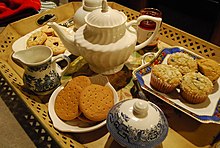
A modernistic British tea prepare, in which a carbohydrate bowl and a milk jug accompany the teapot
Though tea was gaining popularity on its own at the beginning of the 18th century, the addition of sugar to the drink aided its rise in popularity further, equally the British began adding sugar to their tea between 1685 and the early 18th century.[51] At this time, sugar was already used to raise the flavour of other foods among the upper classes and had a reputation every bit an ostentatious luxury.[52] Considering both tea and sugar had condition implications, it made sense to drink them together,[53] and the growth in the import of tea parallels that of sugar in the 18th century,[54] which itself was booming due to the growth of sugar plantations in the Americas.[55]
However, the upper classes of Britain began to care more than about their wellness, and starting in the late 17th century, literature on the unhealthiness of sugar began to circulate.[56] Adding sugar to tea, nonetheless, was seen as an adequate way to swallow saccharide, as it suggested that "one had the self-control to consume saccharide in a good for you way."[56] Saccharide also masked the bitterness of tea, and fabricated it more desirable to potable; as the supply of both tea and saccharide grew during the early 18th century, the combination of the ii became more than universal, and increased popularity and need for both products. Black tea overtook dark-green tea in popularity in the 1720s when it became more common for both sugar and milk to be added to tea, a do originating outside of China.
Popularity among the middle classes [edit]


When the popular English patriotic ballad The Roast Beef of Old England was written in 1731, it portrayed tea (every bit well as coffee) as foreign and un-English, noting that they were rare during the time of Elizabeth I.[57]
Because tea began in U.k. as a luxury for the upper classes, it had a reputation in the 18th century as a high-course commodity; all the same, as prices slowly roughshod, more people at the heart levels of club had access to it. Appropriately, drinking tea became associated with respectability amidst upwardly mobile middle-class people.[58] When people drank tea, they were expected to possess sure manners and behave in a particular way.[58] Shortly, drinking tea became a domestic ritual amongst families, colleagues, and friends who were but wealthy enough to afford it, which also increased demand.[48] The clan betwixt tea and respectability became and so ingrained in both British and Irish culture that it reached a point where it could non leave of fashion.[56] Tea drinking among these groups was also soon considered patriotic.
Because the British East India Company had a monopoly over the tea industry in England, tea became more pop than java, chocolate, and alcohol.[59] Tea was seen as inherently British, and its consumption was encouraged by the British government because of the revenue gained from taxing tea.[threescore] Different coffee and chocolate, which came from the colonies of Britain's rivals in various regions of the world, tea was produced in a single massive colony and served as a means of profit and colonial ability.[56] [60] Mintz goes then far as to contend that the combination of ritualization and increased production in the British colonies was how tea became inherently British.[61]
Equally the British continued to import more than and more tea throughout the 18th century, tea slowly went from a respectable commodity consumed by the well-mannered classes in domestic rituals to an absolute necessity in the British diet, fifty-fifty amongst the poor working classes. John Hanway, an 18th-century social reformer, observed the widespread consumption of tea by the poor in 1767. He described "a certain lane ... where beggars are often seen ... drinking their tea", as well as "laborers mending their roads drinking their tea" and tea "in the cups of haymakers".[62] Just two centuries after the first appearance of tea in English society as a beverage for aristocrats, tea had become so widely popular and available that those at the absolute lesser of the social hierarchy were consuming information technology as their beverage of choice. It was at this point that tea became universal amidst all levels of society. Fernand Braudel asked, "is it true to say the new drink replaced gin in England?"[63]
19th century [edit]
Adoption by the working classes [edit]

Past the 19th century, tea had reached the working class, and it was soon considered an everyday necessity among poor labourers. According to the Scottish historian David MacPherson, tea had become cheaper than beer by the early 19th century.[64] Furthermore, carbohydrate had as well become extremely cheap by this time, and the 2 were virtually always consumed together.[65] Though the price of java had decreased by this point, tea was the preferred drink considering, unlike java, it still tasted good when diluted, which is often how the poor consumed information technology to save money.[66]
Tea had other attractions also. Drinking a hot, sweet beverage helped the meals of the lower classes, which mostly consisted of dry bread and cheese, get downwardly more hands.[5] The warm drink was particularly appealing given Great britain's cold and wet climate.[five] [61] Additionally, tea helped alleviate some of the consequences of industrial urbanization, as drinking tea required boiling the h2o, thereby killing water-borne diseases like dysentery, cholera, and typhoid.[67]
However, the poor consumed tea very differently from the well-mannered ritual adopted past the upper classes. According to Mintz, "tea-drinking amongst the poor probably began in connection with work, non in the habitation".[68] Twenty-four hour period labourers brewed their tea out in the open and brought their tea equipment with them to work, as opposed to the private, domestic ritual that had previously surrounded tea-drinking.[v] Afternoon tea possibly became a manner to increase the number of hours labourers could work; the stimulants in the tea, accompanied past the calorie boost from the saccharide and accompanying snacks, would give workers energy to cease the solar day's work.[61] [67]
Cultivation in India [edit]
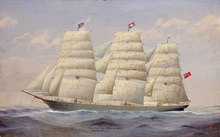
The tea clipper Thermopylae, which launched in 1868
The popularity of tea occasioned the furtive export of slips, a pocket-sized shoot for planting or twig for grafting to tea plants, from China to British India and its commercial cultivation in that location, beginning in 1840. Between 1872 and 1884, the supply of tea to the British Empire increased with the expansion of the railway to the east. The demand, still, was not proportional, which caused prices to ascension. Nevertheless, starting in 1884, innovations in tea preparation caused the price of tea to drop and remained relatively depression through the first one-half of the 20th century. Presently subsequently, London became the middle of the international tea trade.[69] With high tea imports also came a large increase in the demand for porcelain. The demand for teacups, pots, and dishes increased to proceed with the popular new beverage.[44]
Today [edit]
In 2003, DataMonitor reported that regular tea drinking in the United Kingdom was on the refuse.[70] At that place was a ten.25% decline in the purchase of normal teabags in Uk between 1997 and 2002.[seventy] Sales of footing coffee also fell during the same period.[70] Britons were instead drinking health-oriented beverages, like fruit or herbal teas, consumption of which increased 50% from 1997 to 2002. A farther unexpected statistic is that the sales of decaffeinated tea and coffee fell faster than the sale of more mutual varieties during this period.[70] Failing tea sales were matched past an increment in espresso sales.[71] Nevertheless, tea remains an extremely popular drinkable and is all the same ingrained in British culture and society.
Brewing the tea [edit]
Even semi-formal events tin be reason enough to use cups and saucers rather than mugs. A typical British tea ritual might run as follows (the host performing all deportment unless noted):[72]
- The kettle is boiled with fresh water[73]
- Enough boiling water is swirled around the teapot to warm it and is then poured out
- Tea leaves — normally blackness tea, loose or in an infuser — or tea bags are added to the teapot
- Fresh boiling water is poured into the pot over the tea leaves, infuser, or bags, and allowed to brew for two to five minutes. [74]
- The brewed tea is poured into the loving cup, through a tea strainer placed over the top of the cup if loose tea is being used. Infusers or tea bags may be removed once desired strength is attained. A tea cosy may be placed on the pot to keep the tea warm.
- White sugar and milk (in that lodge) may be added, ordinarily by the guest, though milk may be put in the loving cup before the tea.
The pot volition normally hold enough tea then that some remains after filling the cups of all the guests. If this is the case, the tea cosy is replaced after everyone has been served. Hot water may be provided in a separate pot and is used simply for topping up the pot, never for private cups.
Milk and tea [edit]

Tea with milk that has non even so been stirred
"Past putting the tea in first and stirring every bit i pours, one can exactly regulate the amount of milk, whereas one is likely to put in too much milk if one does it the other way round"
—One of George Orwell's eleven rules for making tea from his essay "A Nice Loving cup of Tea", appearing in the London Evening Standard, 12 January 1946.[75]
Whether to put milk into the cup before or afterwards the tea has been a matter of debate since at least the mid-20th century; in his 1946 essay "A Nice Cup of Tea", author George Orwell wrote, "tea is one of the mainstays of civilisation in this country and causes fierce disputes over how it should exist made".[76] Whether to put the tea in the cup first and add the milk after or do the opposite has carve up public opinion, with Orwell stating, "indeed in every family unit in Britain at that place are probably two schools of thought on the subject field".[76]
Another attribute of the fence is the claims that adding milk at different times alters the flavour of the tea (for instance, see ISO 3103 and the Regal Lodge of Chemistry'due south "How to brand a Perfect Cup of Tea"[77]). Some studies suggest that heating milk higher up 75 °C (167 °F) when calculation milk after the tea is poured does cause denaturation of the lactalbumin and lactoglobulin.[78] Other studies contend that brewing fourth dimension has a greater importance.[79] Regardless, when milk is added to tea, it may affect the flavour. In addition to considerations of season, the lodge of these steps is thought to have been, historically, an indication of grade. Just those wealthy enough to afford good-quality porcelain would be confident of its being able to cope with being exposed to boiling h2o unadulterated with milk.[eighty]
A further point of word on when to add milk is how it affects the time taken for the liquid to achieve a potable temperature. While adding milk commencement will cause an initial drop in temperature, which leads to a more than shallow cooling curve and slower cooling while also increasing volume (which would slightly increase the surface expanse through which the tea could lose heat), ane report[ citation needed ] noted that adding milk beginning leads to the tea retaining rut out of all proportion with these effects. The major machinery by which hot tea cools is not conduction or radiation, but evaporative loss, which is affected by the physical properties of the milk.[footnote 1] The written report concluded that lipids in milk prevent h2o from evaporating rapidly, thus retaining estrus longer.[footnote ii]
Drinking etiquette [edit]

Britons as well hold opinions as to the proper way in which to potable tea when using a cup and saucer.[81] Historically, during the 1770s and 1780s, information technology was fashionable to potable tea from saucers. Saucers were deeper than is the current way, and therefore more like to bowls like their Chinese antecedents.[82] If one is seated at a table, the proper manner to drinkable tea is to raise the teacup only, placing it back into the saucer in between sips. When standing or sitting in a chair without a table, one holds the tea saucer with the off-hand and the teacup in the dominant hand. When not in use, the teacup is placed dorsum in the tea saucer and held in 1'due south lap or at waist acme. In either result, the teacup should never be held or waved in the air. Fingers should exist curled inwards; despite popular conventionalities in the United States, no finger should extend away from the handle of the cup.[72]
Tea rooms [edit]

Tea rooms resulted from societal concerns near the working course'due south consumption of alcohol. One response to the perception of widespread dissolution was the temperance movement, which promoted tea as a healthful culling to alcohol of any sort. From the 1830s many new cafes and coffeehouses opened, every bit a place to socialise that was non a pub or an inn.
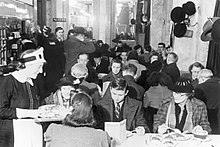
A waitress in a nippy uniform brings cakes to the tabular array of customers enjoying afternoon tea at a Lyon's Corner Firm in London, 1942.
In 1864, the Aerated Bread Company opened the kickoff of what would grow to be known as A.B.C. Tea Shops. The idea came from a London-based "manageress" at ABC "who'd been serving gratis tea and snacks to customers of all classes, [and] got permission to put a commercial public tea room on the bounds".[83] Past 1923, the A.B.C. tea shops had 250 branches,[84] second only to J. Lyons and Co. Lyons Corner Houses started in 1894 and soon became the leading chain of tea rooms; their waitresses were known equally "nippies" for the speed of their work.
In 1878, Catherine Cranston opened the first of what became a concatenation of Miss Cranston'south Tea Rooms in Glasgow, providing elegant, well-designed social venues which, for the first fourth dimension, provided for well-to-do women socialising without male company. They proved to be widely pop. She engaged up-and-coming designers and became a patron of Charles Rennie Mackintosh. He designed the complete building of the Willow Tearooms, which featured a strikingly modern outside and a series of interesting interior designs. Like establishments became popular throughout Scotland. The Glasgow Willow Tearooms building was fully restored between 2014 and its reopening in July 2018.
Tea rooms were as well significant since they provided a place where women in the Victorian era could have a meal without a male person escort, without risk to their reputations. Roger Fulford argues that tea rooms benefitted women in that these neutral public spaces were instrumental in the "spread of independence" for women and their struggle for the vote.[85] Paul Chrystal characterises tea rooms as "popular and fashionable, especially with women", providing them with a dignified and safe identify to come across, consume, and strategise on political campaigns.[86]
There is a long tradition of tea rooms within London's hotels. For instance, Brownish'southward Hotel has been serving tea for over 170 years.[87] Since the 1880s, fine hotels in both the UK and the Usa featured tea rooms and tea courts, and by 1910 they had begun to host afternoon tea dances every bit dance crazes swept both countries.
Tea rooms of all kinds were widespread in Britain by the 1950s, but in the following decades cafés became more fashionable, and tea rooms became less mutual. Still, there are still plenty of places that offer the opportunity to enjoy afternoon tea, a luxurious lite meal of savoury snacks (tea sandwiches) and pocket-sized pastries. A less formal alternative is a foam tea, specially popular in the West Country, featuring a scone with jam and clotted foam. Another possibility is the high tea, hot savoury food as the twenty-four hours's final (but relatively early) repast. There are plenty of regional variations. In Scotland, for instance, teas are usually served with scones, pancakes, crumpets, and other cakes.
Tea as a pause [edit]
British workers, by police, accept the right to a minimum of a xx-minute suspension in a shift of six hours; government guidelines describe this as "a tea or lunch suspension".[88] When taken in the morn, this may be informally referred to every bit elevenses, served around xi a.m. A mug of builder's tea is a common beverage seen in a quick tea break in the working solar day.
Tea as a meal [edit]

Tea is non just the name of the beverage merely also of a lite repast. Anna Maria, Duchess of Bedford, is credited with its creation, circa 1840. The notion of cakes or a calorie-free repast with tea passed to teahouses or tea rooms. In the West Land, foam teas are a speciality: scones, clotted cream and jam accompany the drink. Afternoon tea, in contemporary British usage, usually indicates a special occasion, perhaps in a hotel dining room, with savoury snacks (tea sandwiches) too as small sweet pastries. Queen Victoria was known to enjoy sponge block with her afternoon tea – after the invention of baking powder past Alfred Bird in 1843 which immune the sponge to ascension higher in cakes, a patriotic cake, Victoria sponge, was created, named after the Queen.
A social effect to savor tea together, usually in a private domicile, is a tea political party.
Tea or loftier tea tin can also refer to a savoury, hot, early evening repast. This usage is common in working-class British English and in Northern England, Scotland, and Northern Ireland.
Tea cards [edit]

Spousal relationship Pacific Tea Co. advertizement carte du jour
In the United kingdom of great britain and northern ireland, a number of varieties of loose tea sold in packets from the 1940s to the 1980s contained tea cards. These were illustrated cards roughly the same size every bit cigarette cards and intended to be collected by children. Some of the best known were Typhoo tea and Brooke Bond cards, the latter of whom also provided albums for collectors to proceed their cards in. In the brand named Brooke Bond Dividend D, the carte was a dividend ("divvy") against the cost of the tea.
Some renowned artists were deputed to illustrate the cards, including Charles Tunnicliffe. Many of these carte collections are at present valuable collectors' items.
A related phenomenon arose in the early 1990s when PG Tips released a series of tea-based pogs with pictures of cups of tea and chimpanzees on them. Tetley's tea released competing pogs only never reached the popularity of the PG Tips variety.[ commendation needed ]
Come across besides [edit]
Drinks [edit]
- Builder's tea
- Earl Grey tea, a classic English blended tea, flavoured with bergamot essential oil
- English breakfast tea
- Irish breakfast tea
- Prince of Wales tea blend
- Gunfire (potable), a cocktail made of tea and rum served in the British Army
Food [edit]
- Teacake
- Tea sandwich
Appliances [edit]
- Boiling vessel a water heater for apply in cooking & preparing tea fitted to British Army battle tanks
- Brown Betty (teapot), an iconic type of teapot fabricated from British red clay, known for being rotund and glazed with brown manganese
- Cube teapot, a heavy-duty type of teapot invented for making tea on ships
- Teasmade, an English apparatus that combines a kettle and a teapot to make tea automatically by alarm clock
- Tea set, a fix consisting of a tea pot, carbohydrate bowl and milk jug
Other [edit]
- List of tea companies in the United Kingdom
- London Tea Auction, 1679–1998
- TV pickup, a daily spike in power consumption in the Great britain due to the utilize of electric kettles
- Tea lady
- National Tea Day
- Tea culture in Ireland
Footnotes [edit]
- ^ Water molecules whose temperature is far above the average temperature of the tea escape and information technology is only these in a higher place average temperature molecules that accept sufficient energy to escape the surface of the tea. As the tea'southward temperature drops the rate of evaporation, and thus charge per unit of oestrus loss by evaporation, besides drops and evaporative loss becomes a minor mechanism.
- ^ For this reason Chinese tea cups come up with lids to retain estrus as it is common practise in Mainland china to add tea leaves to a cup and brew in the cup and so the h2o temperature must exist kept loftier for sufficient time. Also, insulated cups/travel mugs for hot beverages come with lids as it is anticipated that the potable will exist imbibed some while afterwards beingness heated.
References [edit]
- ^ "Food Balance Sheets". Food and Agronomics Organisation of the United nations.
- ^ a b Woodruff D. Smith, "Complications of the Commonplace: Tea, Sugar, and Imperialism". Periodical of Interdisciplinary History (Autumn 1992), 259–277.
- ^ "A very British drinkable: Why united states Brits simply dearest a cuppa". Express. 23 September 2016.
- ^ "A History of Ireland and Tea". Irish at Heart . Retrieved nine March 2021.
- ^ a b c d e Mintz 1993, p. 266
- ^ "The importance of tea in the British culture". Breaking Blueish . Retrieved 9 March 2021.
- ^ Ukers 1935, pp. 23–46
- ^ Ellis, Coulton & Mauger 2015, pp. 31–76
- ^ Mintz 1993, pp. 261–270
- ^ Mintz 1985, pp. 110–117
- ^ Giambattista Ramusio, Navigatione et Viaggi, Vol. Two, Venice, 1559, in Ukers 1935, pp. 23–24
- ^ January Hugo Van Linschooten, Voyages and Travels, London, 1598, in Ukers 1935, p. 501
- ^ a b Ukers 1935, p. 37
- ^ a b Samuel Purchas, Purchas His Pilgrimes, Vol. III, London, 1625, in Ukers 1935, p. 38
- ^ Chrystal, Paul (2014). Tea: A Very British Drinkable. Amberley Publishing Limited.
- ^ "The Different Types of Tea in Britain - There Are Many". The Bandbox Eats . Retrieved 9 March 2021.
- ^ Ukers 1935, p. 38
- ^ Mair, Victor H.; Hoh, Erling (2009). The True History of Tea. Thames & Hudson. p. 169. ISBN978-0-500-25146-1.
- ^ a b Ukers 1935, p. 41
- ^ Ferguson, Niall (2004). Empire: the rise and demise of the British world order . p. eleven. ISBN9780465023295.
- ^ Rugge'southward Diurnall is preserved in the British Library (Add MS 10116-10117); it was published equally The diurnal of Thomas Rugg, 1659-1661, William Lewis Sachse ed., (1961).
- ^ John MacGregor (1850). Commercial Statistics. a Digest of the Productive Resources, Commercial Legislation, Customs Tariffs, Navigation, Port, and Quarantine Laws, and Charges, Shipping, Imports and Exports, and the Monies, Weights, and Measures of All Nations. p. 47. ISBN978-1130006230.
- ^ Smith, Westward. J., ed., Herbert Correspondence, Academy of Wales (1963), pp. 204–205 no. 353, John Read to Richard Herbert of Oakly Park, Ludlow, 29 June 1672.
- ^ Ukers 1935, p. 31
- ^ a b Nicolas Tulp, Obersaciones Medicae, Amsterdam, 1641, in Ukers 1935, pp. 31–32
- ^ Thomas Garway, "An Verbal Description of the Growth, Quality, and Vertues of the Leaf TEA", 1660, preserved in the British Museum, in Ukers 1935, pp. 38–39
- ^ Ellis, Coulton & Mauger 2015, pp. 32, 34
- ^ Thomas Povey, Esq., "A Famous Tea Manuscript of 1686", twenty October 1686, in Ukers 1935, p. twoscore
- ^ Smith, 296.
- ^ Shapin, Steven (30 July 2015). "Pretence for Prattle". The London Review of Books. 37 (15): 17–18. Retrieved 24 July 2015.
- ^ Ellis, Coulton & Mauger 2015, p. 43
- ^ a b Ellis, Coulton & Mauger 2015, p. 31
- ^ Antman, Francisca One thousand. (2022). "For Want of a Cup: The Rise of Tea in England and the Bear on of Water Quality on Mortality". The Review of Economics and Statistics. doi:10.1162/rest_a_01158. ISSN 0034-6535.
- ^ Ellis, Coulton & Mauger 2015, p. 36
- ^ Richard, Lord Braybrooke, ed., note in The Diary and Correspondence of Samuel Pepys, F.R.S., vol. I :109.
- ^ "A very Purple Wedding ceremony - Charles II and Catherine of Braganza".
- ^ Smith, 268.
- ^ Mintz 1993, p. 110
- ^ Wilhelm, Kendra Hunt. "Tea Comes to England". Tea.
- ^ Ellis, Coulton & Mauger 2015, p. 39
- ^ Ukers 1935, p. 46
- ^ Sir George Staunton'south figure, starting in 1693, is quoted, e.grand., in Walvin, James. 1997. "A taste of empire, 1600-1800". (cover story). History Today 47.ane (2001: 11).
- ^ Braudel 1981:251.
- ^ a b Guerty, P. K.; Switaj, Kevin (i April 2004). "Tea, porcelain, and saccharide in the British Atlantic world". OAH Mag of History. 18 (3): 56–59. doi:10.1093/maghis/eighteen.3.56.
- ^ Ellis, Coulton & Mauger 2015, p. 37
- ^ a b c Smith, 273.
- ^ Smith, 274.
- ^ a b Smith, 275.
- ^ "Smuggling and the British Tea Trade before 1784". The American Historical Review. October 1968. doi:10.1086/ahr/74.1.44. ISSN 1937-5239.
- ^ A Mystery Drink – The History Of Tea. History Television receiver. half-dozen June 2016. Archived from the original on 21 December 2021. Retrieved five March 2019.
- ^ Smith, 263.
- ^ Smith, 266.
- ^ Smith, 270.
- ^ "Tea". In Our Fourth dimension. 29 Apr 2004. BBC Radio four.
- ^ Smith, 271.
- ^ a b c d Smith, 277.
- ^ "The Roast Beef of Old England. Henry Fielding (1707-1754). I. Patriotism. Elation Carman, et al., eds. 1904. The World'southward All-time Poesy. Eight. National Spirit".
- ^ a b Smith, 276.
- ^ Mintz 1985, p. 113
- ^ a b Mintz 1985, p. 114
- ^ a b c Mintz 1985, p. 110
- ^ Jonas Hanway, 1767, in Mintz, 117.
- ^ Braudel 1981:252.
- ^ David MacPherson, The History of European Commerce with Republic of india (London: Longman, Hurst, Rees, Orme, & Chocolate-brown, 1812), 132, in Mintz 1993, p. 264
- ^ Mintz 1993, p. 264
- ^ Mintz 1985, p. 112
- ^ a b Macfarlane, Alan. "Tea and the Industrial Revolution" (Movie).
- ^ Mintz 1993, p. 265
- ^ Nguyen, D. T.; Rose, M. (1987). "Demand for tea in the Great britain 1874-1938: An econometric study". Periodical of Development Studies. 24 (ane): 43. doi:10.1080/00220388708422054.
- ^ a b c d "Britons have less time for tea". Nutrient & Drink. 16 June 2003. Retrieved xvi May 2010.
- ^ "Espresso cups outsell mugs". The Telegraph. 11 November 2011.
- ^ a b "All Nigh British Tea". URBANARA Infographic. Guide to British Tea Time. [ dead link ]
- ^ "The perfect loving cup". Twinings.
- ^ Alleyne, Richard (15 June 2011). "How to brand the perfect cup of tea – exist patient". The Daily Telegraph. Archived from the original on 18 June 2011. Retrieved 28 May 2014.
- ^ "How to make a perfect cuppa: put milk in first". The Guardian . Retrieved 30 December 2014.
- ^ a b George Orwell, Ian Angus, Sheila Davison (1998). The Complete Works of George Orwell: Smothered nether journalism, 1946. p. 34. Secker & Warburg
- ^ "How to make a Perfect Cup of Tea" (PDF). Royal Society of Chemical science. 2003. Archived from the original (PDF) on eleven Baronial 2014.
- ^ Rowland, Due south. J. (Dec 1933). "The Estrus Denaturation of Albumin and Globulin in Milk". Periodical of Dairy Inquiry. 5 (1): 46–53. doi:10.1017/S0022029900000911.
- ^ Kyle, J. A.; Morrice, P. C.; McNeill, K.; Duthie, G. M. (2007). "Effects of Infusion Time and Add-on of Milk on Content and Assimilation of Polyphenols from Black Tea". Periodical of Agricultural and Food Chemistry. 55 (12): 4889–4894. doi:10.1021/jf070351y. PMID 17489604.
- ^ Beverly Dubrin (1 October 2010). Tea Culture: History, Traditions, Celebrations, Recipes & More. Charlesbridge Publishing. p. 24. ISBN978-1-60734-363-9 . Retrieved 22 Apr 2012.
- ^ Sapsted, David (8 August 2007). "Tea room outlaws biscuit dunking". The Daily Telegraph . Retrieved 28 May 2014.
- ^ Titus, Susan. "Tea: A Brief History". Retrieved 25 Apr 2016.
- ^ Brandt, Pamela Robin. "Tea for View, View for Tea," Miami New Times. Oct 17, 2002. (Retrieved 2009-05-08). See also: "英格兰饮茶风俗由何而来? (二)," British Council Communist china. August 8, 2007. (Retrieved 2009-05-08).
- ^ "Aerated Bread Company (ABC)", London Metropolitan Archives. National Archives. ACC/2910, 1869–1885. (Retrieved 2009-05-08).
- ^ Votes for Women 1957, quoted in Tea: A Very British Potable by Paul Chrystal 2014.
- ^ Chrystal, Paul (2014). Tea: A Very British Beverage.
- ^ "Luxury Hotels - 5 Star Hotels and Resorts - Rocco Forte". Browns Hotel. Archived from the original on 28 Oct 2007.
- ^ "Rest breaks at piece of work". gov.uk . Retrieved ix May 2016.
Sources [edit]
- Ellis, Markman; Coulton, Richard; Mauger, Matthew (2015). Empire of Tea: The Asian Leaf that Conquered the Globe. Islington, United Kingdom: Reaktion Books.
- Mintz, Sidney Westward. (1993). "The Changing Roles of Food in the Study of Consumption". In Brewer, John; Porter, Roy (eds.). Consumption and the Globe of Goods. New York: Routledge.
- Mintz, Sidney W. (1985). Sweet and Ability. New York: Penguin Books.
- Ukers, William H. (1935). All About Tea: Vol. I. New York: The Tea and Coffee Trade Periodical.
Further reading [edit]
- Julie E. Fromer. A Necessary Luxury: Tea in Victorian England (Ohio University Printing, 2008), 375pp
- Hobhouse, Henry (1987). Seeds of Change: Six Plants that Transformed Flesh. Harper. ISBN978-0060914400.
External links [edit]
- Tea, BBC Radio 4 discussion with Huw Bowen, James Walvin & Amanda Vickery (In Our Fourth dimension, 29 Apr 2004)
vitaglianothall1989.blogspot.com
Source: https://en.wikipedia.org/wiki/Tea_in_the_United_Kingdom
0 Response to "Average Number of Packets Per Second for Family"
Post a Comment